How to Sleep After Wisdom Teeth Removal: Positioning, Timing, and Comfort Tips
Struggling to sleep after wisdom teeth removal? Learn the right sleeping position, why elevation matters, how to manage night-time pain, and when sleep returns to normal.
After Care
Sleep after wisdom teeth removal is one of the most underestimated challenges of recovery. Patients prepare carefully for what to eat and how to manage pain during the day — then discover that the first two or three nights are genuinely difficult in ways nobody warned them about.
The good news is that most night-time discomfort is manageable with a few specific adjustments. This guide covers the correct sleeping position and why it matters clinically, how to handle pain that peaks overnight, and a realistic timeline for when sleep returns to normal.
Key Takeaways
Sleep with your head elevated above your heart for at least the first 3 nights — this measurably reduces swelling and throbbing.
Side sleeping is generally acceptable after the first night, but avoid pressing the surgical side directly into the pillow.
Pain often feels worse at night because of lying flat, fewer distractions, and medication timing gaps.
Timing your pain medication to cover the overnight window is one of the most effective comfort strategies.
Most patients return to normal sleep positions and quality by night 4 or 5.
The Correct Sleeping Position
Elevate Your Head — This Is the Core Rule
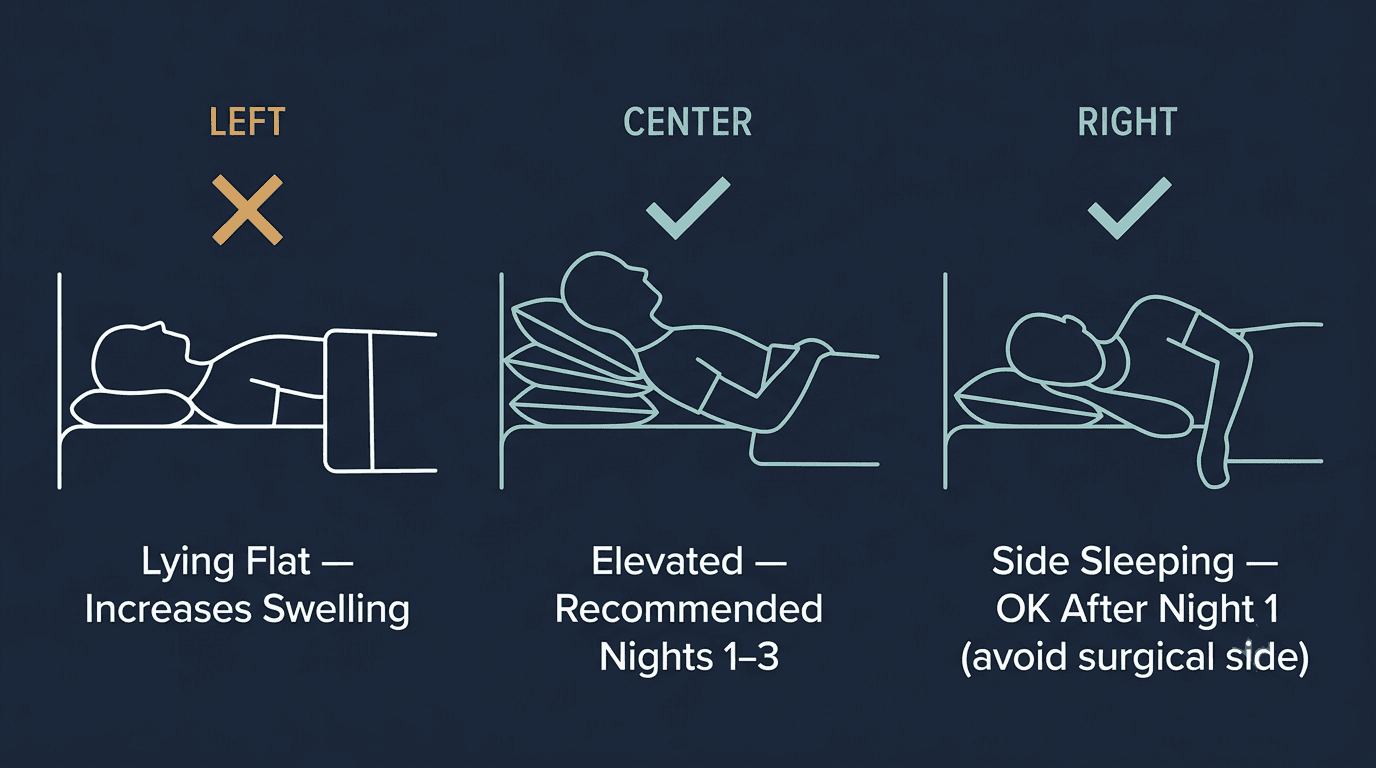
Sleep with your head elevated above the level of your heart for at least the first 3 nights after surgery. This is not a comfort suggestion — it's a clinical one with a direct physiological rationale.
When you lie flat, blood flow to the head increases and fluid accumulates in the surgical area. This raises pressure at the extraction sites, which increases both swelling and the throbbing sensation many patients experience overnight. It can also contribute to increased oozing from the sockets. Elevation uses gravity to reduce fluid pooling, which directly reduces swelling and discomfort.
How to Achieve Proper Elevation
Stacked pillows: The simplest approach — two to three pillows arranged to support your head, neck, and upper back together. Avoid stacking pillows under only your head, which bends the neck sharply and causes neck strain.
Wedge pillow: A foam wedge provides more even support across the upper body and holds its shape better through the night than stacked pillows, which tend to shift.
Recliner: Many patients find the first night or two most comfortable in a recliner, which naturally maintains elevation without requiring active positioning.
Adjustable bed: If available, raising the head of the bed 30 to 45 degrees is ideal.
Back Sleeping vs. Side Sleeping
Night 1: Sleeping on your back with elevation is the safest option. It avoids any direct pressure on the surgical sites and keeps elevation consistent.
Nights 2 and beyond: Side sleeping is generally acceptable, with one caveat — avoid lying directly on the side where extractions were performed. If teeth were removed on both sides, alternate sides rather than staying on one for the whole night, and keep a pillow arrangement that maintains some elevation.
Stomach sleeping: Avoid this for at least the first 3 to 4 nights. It places direct pressure on the face and jaw and makes elevation essentially impossible to maintain.
Why Pain Often Feels Worse at Night
Many patients report that their discomfort peaks in the evening or overnight, then improves during the day. Several factors converge to produce this pattern:
Positional: Lying down increases blood flow to the head, raising pressure in the surgical area.
Medication timing gaps: Pain relief taken in the early evening may wear off in the middle of the night, leaving several hours uncovered.
Fewer distractions: During the day, activity and attention divert focus. At night, with nothing else competing for attention, the same level of discomfort registers more intensely.
Natural swelling cycle: Swelling generally builds over the first 48 to 72 hours, which means nights 2 and 3 often coincide with peak swelling.
Managing Night-Time Pain
Time Your Medication to Cover the Night
This is the single most effective strategy. Take your prescribed or over-the-counter pain medication shortly before going to bed, timed so that its coverage window extends through the majority of your sleep. Follow the specific dosing schedule your surgical team provided — do not exceed recommended doses or shorten intervals to try to extend coverage.
If pain consistently wakes you in the middle of the night despite bedtime dosing, mention this to your surgical team. They can advise on adjusting the timing or approach within safe limits.
Ice Before Bed on Nights 1 and 2
Apply a cold compress to the outside of the jaw for 15 to 20 minutes shortly before sleeping during the first 48 hours. This reduces both swelling and the throbbing sensation, giving you a better starting point as you fall asleep.
Keep Water Within Reach
Dry mouth is common after surgery, particularly with mouth breathing due to swelling. Keep water on the nightstand and sip as needed — remembering not to use a straw. Staying hydrated also supports healing generally.
Protect Your Bedding on Night 1
Light oozing from the extraction sites is normal during the first night. Place an old towel or a dark pillowcase over your pillow to avoid staining. This is a practical detail that saves frustration and is entirely expected.
Questions about your recovery or night-time discomfort? Call (801) 370-0050 — Mon–Fri 8am–5pm. Both Provo and Murray offices are here to help.
Night-by-Night: What to Expect
Night 1
The most disrupted night for most patients. Residual grogginess from IV sedation may actually help with falling asleep initially, but discomfort as local anesthesia fully wears off can wake you. Sleep on your back, well elevated. Light oozing is normal. Expect broken sleep.
Nights 2 and 3
Often the most uncomfortable nights, coinciding with peak swelling. Maintain elevation consistently. Continue bedtime medication timing. Side sleeping is acceptable now, avoiding the surgical side where possible. Many patients find these nights harder than night 1.
Nights 4 and 5
Noticeable improvement for most patients. Swelling is reducing, and pain is typically manageable enough that it no longer interrupts sleep consistently. Elevation can be gradually reduced, though many patients find continuing it comfortable.
Night 6 and Beyond
Most patients with uncomplicated extractions return to their normal sleeping position and sleep quality around this point. If you are still experiencing significant night-time pain that disrupts sleep after day 5, this is worth mentioning to your surgical team — worsening or persistent pain at this stage can indicate a complication such as dry socket.
What to Avoid at Night
Sleeping flat during the first 3 nights: Increases swelling and throbbing.
Sleeping directly on the surgical side: Adds pressure to a healing site and can increase discomfort.
Alcohol as a sleep aid: It interacts with prescribed pain medications and antibiotics, thins the blood, and disrupts sleep quality despite the initial drowsiness.
Falling asleep with gauze in your mouth: A choking risk. Remove gauze before sleeping unless specifically instructed otherwise by your surgical team.
Very hot showers before bed on day 1: Heat increases blood flow and can worsen swelling and bleeding early in recovery.
Frequently Asked Questions
How long do I need to sleep elevated?
At minimum, the first 3 nights. Many patients find continuing elevation through night 4 or 5 more comfortable as swelling resolves. There's no harm in continuing longer if it feels better — the primary benefit is concentrated in the first 72 hours when swelling peaks.
Can I sleep on my side after wisdom teeth removal?
Generally yes, starting from night 2. Avoid lying directly on the side where teeth were extracted. If teeth were removed on both sides, alternating sides through the night is better than remaining on one. Keep some head elevation regardless of position.
Is it normal to wake up with blood on my pillow?
Light oozing and pink-tinged saliva on the first night is normal and expected. Significant fresh bleeding that soaks through bedding, or bleeding that continues heavily beyond the first night, is not typical — contact your surgical team if this occurs.
Why does my ear hurt when I lie down?
Referred pain to the ear is common with lower wisdom tooth extractions, as the nerves serving the lower jaw run near ear structures. Lying down can make this more noticeable. It typically resolves alongside the general recovery timeline. Persistent or worsening ear pain after day 3 to 5 warrants evaluation.
I can't sleep at all because of anxiety about the recovery. What can I do?
Post-surgical anxiety affecting sleep is more common than most patients expect. Basic sleep hygiene helps: consistent bedtime, dim lighting, no screens for an hour before bed, and slow breathing exercises. Do not take any sleep aid or additional medication not cleared by your surgical team, since interactions with prescribed pain medication are a genuine concern. If anxiety is significantly disrupting your recovery, mention it when you call the office.
The Bottom Line
Sleep after wisdom teeth removal improves substantially with a few specific adjustments: elevate your head above your heart for the first 3 nights, avoid sleeping directly on the surgical side, time your pain medication to cover the overnight window, and use a cold compress before bed during the first 48 hours.
Nights 2 and 3 are typically the hardest, coinciding with peak swelling. Most patients are sleeping close to normal again by night 5. If night-time pain is worsening rather than improving after day 3, that's a signal to check in with your surgical team rather than pushing through it.
Schedule your procedure or ask a recovery question: drwisdomteeth.com | (801) 370-0050 | Mon–Fri 8am–5pmProvo: 2230 N University Pkwy #8A | Murray: 5888 S 900 E #101

Written by
Dr. Wisdom Teeth
Resources